The Samsung Galaxy S22 Plus is a really good phone. I enjoy using it. The cameras are better, the haptics are excellent, and that green finish is absolutely gorgeous. But enjoying a phone and recommending that somebody spend $999 on it are two different things.
For most people comparing these two phones at their launch-era prices, I would buy the Galaxy S21 FE and keep the extra $300 to $400. You give up a few things, but you get remarkably close to the same everyday Samsung experience.
That might sound funny coming from somebody who initially thought the S21 FE didn't make much sense. The problem was never that it was a bad phone. The problem was where Samsung put it, when it arrived, and how much Samsung wanted for it.
Quick Summary
- The S21 FE delivers a similar everyday experience for $300 to $400 less at the compared prices.
- The S22 Plus offers noticeably better cameras, excellent haptics, and faster wired charging.
- Both phones have 4,500mAh batteries, Samsung DeX, and the same announced software support commitment.
- The S22 Ultra offers a clearer premium upgrade for buyers already considering flagship-level spending.
The Pricing Problem Samsung Created
The Galaxy S21 FE launched at $699, just weeks before the Galaxy S22 family arrived. The regular S22 started at $799, while Google's Pixel 6 was sitting at $599. That put the FE in an awkward position: spend $100 more for the newer Samsung flagship, or spend $100 less for the Pixel.
Had the S21 FE arrived a couple of months earlier, its positioning might have made more sense. As it stood, the timing made an otherwise solid phone harder to appreciate.
Then there's the S22 Plus. At $999, you're getting a 1080p-class display rather than the Ultra's higher-resolution screen, and you don't get the Ultra's top camera hardware. I'm sorry, but at a thousand dollars, I expect Samsung to give me something a little more premium.
The launch-era price ladder explains the dilemma:
- Galaxy S21 FE: $699, with promotions bringing its effective cost lower.
- Galaxy S22: $799, but with a smaller screen and battery.
- Galaxy S22 Plus: $999, with a larger screen but without the Ultra's full hardware package.
- Galaxy S22 Ultra: $1,199, with the higher-end display, camera system, and built-in S Pen.
I bought my S21 FE with a $100 Best Buy gift card promotion. That made its effective cost $599, although a gift card isn't the same thing as an immediate cash discount. Against a $999 S22 Plus, that's effectively a $400 difference.
That's real money. A phone doesn't become a smart purchase just because thousand-dollar phones have become common.
Performance: The S21 FE Is No Slouch
The S21 FE uses the Snapdragon 888, while the S22 Plus moves up to the Snapdragon 8 Gen 1 in the versions I'm comparing. Yes, the newer processor is more powerful. No, that doesn't mean the older one suddenly feels slow.
Here are the main hardware differences that matter to this comparison:
- Processor: Snapdragon 888 in the S21 FE versus Snapdragon 8 Gen 1 in the S22 Plus.
- Memory: 6GB or 8GB of RAM in the S21 FE, compared with 8GB in the S22 Plus.
- Starting storage: 128GB on both.
- Main rear camera: 12 megapixels on the S21 FE versus 50 megapixels on the S22 Plus.
- Wired charging support: Up to 25W on the S21 FE versus 45W on the S22 Plus.
In ordinary use, I don't feel a meaningful performance gap that makes me want to spend several hundred dollars more. The Snapdragon 888 is still a very capable chip. Whatever advantage the newer processor has on paper, it isn't transforming my everyday experience.
I think of the S21 FE as delivering much of the appeal of an S21 Plus in a later, more affordable package. It isn't identical, but that gets at why it works: you're getting a lot of flagship experience without paying the newest flagship price.
And while I'm on the subject of value, I think the S22 Plus should start with 256GB of storage at $999. My carrier purchase was the 128GB version because I missed the preorder storage promotion. A temporary promotion is nice, but I'd rather see more storage included as standard.
Displays and Comfort: Bigger Isn't Automatically Better
The Galaxy S21 FE has a 6.4-inch screen. The S22 Plus has a 6.6-inch screen. Both give you a comfortably large display, and that extra 0.2 inches doesn't create a night-and-day difference.
I do think the S22 Plus screen looks a little better in actual use. It's a very nice display, and I don't want the pricing criticism to suggest otherwise. The S21 FE's screen is good, too.
My objection is what Samsung is offering for the money. At $999 and 6.6 inches, I want a Quad HD+ display. Higher resolution can come with a battery-life tradeoff, but I still think it belongs in a phone positioned at this price.
Where the FE wins me over is comfort. It's slightly narrower, which makes it easier to manage with one hand. The 6.4-inch size feels like a sweet spot: large enough to be enjoyable, but still comfortable after putting a case on it.
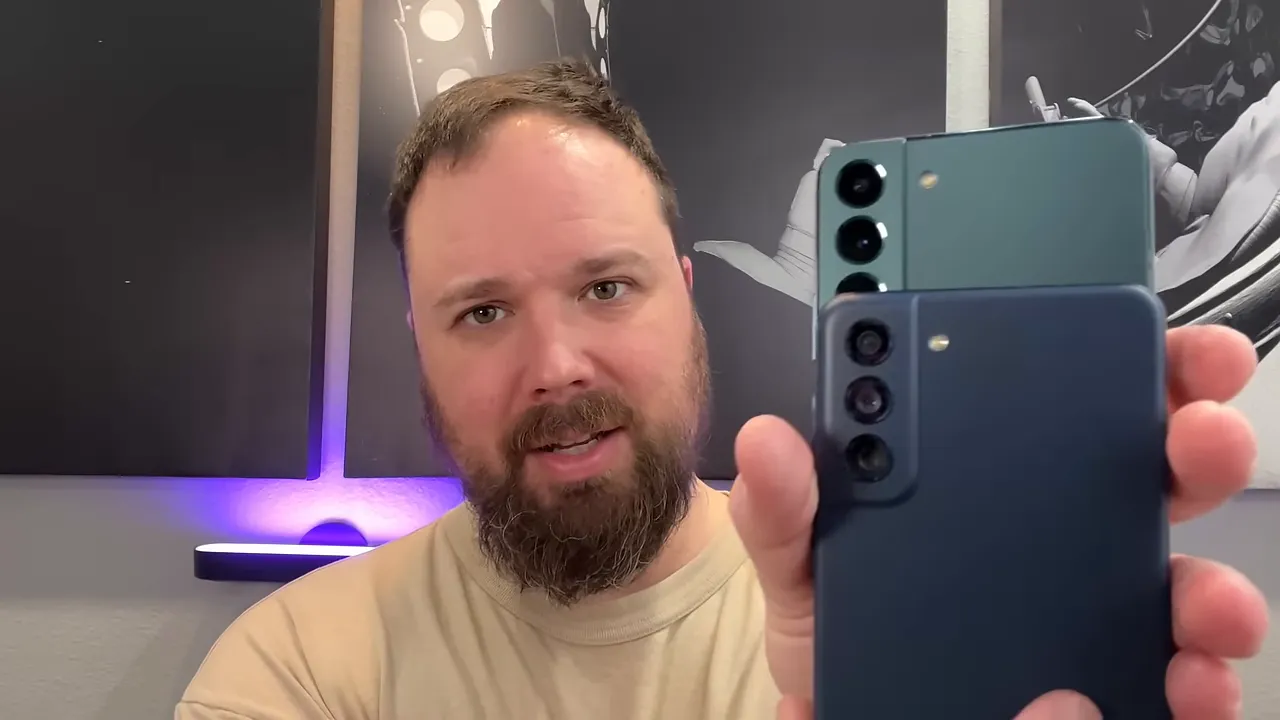
Both phones have thin, pleasant form factors. I also like the textured back on the S21 FE. It's a nicely designed phone, not something that feels like a punishment for spending less. The green S22 Plus is beautiful, but the FE holds its own as something I actually want to carry.
Cameras: The Strongest Reason to Pay More
If there's one area where the S22 Plus makes a convincing argument, it's photography.
The S21 FE cameras aren't quite where I'd like them to be. To me, the results feel closer to an older generation of camera hardware. Processing and computational photography can help, but there's only so much they can do.
The S22 Plus cameras are noticeably better, and that difference isn't just about a 50-megapixel specification replacing a 12-megapixel one. What matters is the result.
The selfie camera stood out in particular. In my use, the S22 Plus did a better job with:
- Managing difficult lighting and HDR.
- Avoiding overexposed areas.
- Handling color and saturation.
- Producing a more pleasing overall selfie.
If selfies and camera quality are major priorities, the S22 Plus deserves a serious look. This is an upgrade you can appreciate without needing to search for a difference.
The regular S22 is another option for someone who wants the newer cameras without paying Plus money. My hesitation there is its 3,700mAh battery. I don't think that's quite enough, and it makes the smaller phone a less appealing alternative for my own use.
For somebody who mainly wants a capable daily driver, though, the FE's camera compromises are easier to accept when the savings reach $300 or $400.
Battery Life and Charging: Similar Endurance, Different Speeds
Both the S21 FE and S22 Plus have a 4,500mAh battery. In my experience, their battery life is broadly similar.
The newer processor and adaptive software features can influence power use, but I wouldn't buy the S22 Plus expecting a dramatically different endurance experience. Heavy screen use still drains a battery, whichever phone you're holding.
I like the 4,500mAh capacity for these designs. It gives both phones a useful battery size without turning either one into something bulky and uncomfortable.
The clearer distinction is charging support. The S21 FE tops out at 25W wired charging, while the S22 Plus supports up to 45W. That's a legitimate advantage for the Plus, but charging speed alone doesn't justify the full price gap for me.
Haptics: A Small Detail That Makes the Plus Feel Better
There's another difference that deserves more attention than it usually gets: the vibration motor.
The S21 FE's haptic feedback is okay. The S22 Plus haptics are excellent. Typing on it is genuinely enjoyable, and those little tactile responses make the phone feel more refined.
This is one of the upgrades I notice in everyday use, even when I don't notice the newer processor. It doesn't make the FE unpleasant to use, but it helps explain why the Plus can feel nicer despite delivering a broadly similar experience.
The question is whether better haptics, better cameras, a slightly nicer display, and faster charging are worth several hundred dollars to you. They're real improvements. I just don't think they add up to the asking price for most people.
Software Support and Samsung DeX Aren't Reasons to Spend More
The FE also makes a strong case on software. Samsung included both phones in its commitment to four generations of operating system upgrades and up to five years of security updates.
That's the support commitment made for these devices, not a fresh support period beginning whenever somebody buys one. At launch, however, it was an important point: these phones arrived only weeks apart, and choosing the FE didn't mean accepting a dramatically older software-support proposition.
Both phones also support Samsung DeX. You don't have to move up to the Plus to keep that useful part of Samsung's feature set.
At an effective $599, the FE also competed directly with the Pixel 6. Given the bugs and problems some Pixel 6 owners were experiencing at the time, along with Samsung's longer operating system upgrade commitment, I thought the FE made an especially strong alternative.
Why the S22 Ultra Makes the Plus Harder to Recommend
A lot of my frustration with the S22 Plus comes down to Samsung's product decisions.
The S22 Ultra effectively brought the Note back, complete with a boxier design and an integrated S Pen. That's great if you wanted another Note. It isn't necessarily great if you wanted an Ultra-level Galaxy S phone without the Note shape or stylus compartment.
The Note had a smaller audience than the combined Galaxy S lineup. Folding those two identities together left some buyers in an awkward spot: accept the Note-style Ultra, or step down to the Plus and lose some of the hardware they wanted.
I like the S22 Ultra a lot. Its display is one of the most beautiful I've used, the 120Hz experience is excellent, and I've found the S Pen useful. Personally, I prefer the larger optional stylus approach of the S21 Ultra over the small pen stored inside the S22 Ultra, but having a pen available can still come in handy.
The Ultra's camera system also gives it a clearer identity. Its 108-megapixel main camera and extended zoom capability distinguish it from the Plus. I was particularly impressed by how much Samsung had improved the long-range experience compared with earlier Ultra models. The 100x zoom felt more like a gimmick on the S20 Ultra; by the S22 Ultra, I found the results much more impressive.
That creates pressure on the Plus from both directions. The FE gets you close to its everyday experience for much less, while the Ultra offers more distinctive hardware for another $200.
I would have appreciated a Plus with a Quad HD+ screen and the 108-megapixel main camera, even if Samsung had priced it at $1,049 or $1,099. Alternatively, the existing package would have made more sense to me around $899. Those are the kinds of changes that would have made the lineup easier to recommend.
My Pick: Galaxy S21 FE for Most People
I don't want to confuse criticism of Samsung's pricing with criticism of how the S22 Plus works. It's a very enjoyable phone. If you want the better cameras, excellent haptics, larger display, and faster charging without moving to the Ultra, there are good reasons to choose it.
But if I'm spending my own hard-earned money at the prices discussed here, I'm buying the S21 FE.
It gives me strong performance, a comfortable 6.4-inch form factor, comparable battery life, Samsung DeX, and the same announced level of software support. The compromises are mostly concentrated in camera quality, haptic feedback, and charging speed, rather than the core experience of using the phone every day.
My recommendation breaks down pretty simply:
- Choose the S21 FE for the better value and a comfortable large-screen Samsung experience.
- Choose the S22 Plus if its camera improvements and everyday refinements matter enough to justify the premium.
- Consider the S22 Ultra if you're already spending flagship money and want the higher-end display, more ambitious camera system, and S Pen.
The S21 FE's launch timing didn't make much sense to me. The phone itself absolutely does, especially with a good discount. At $300 to $400 less than the S22 Plus, it's the one I'd pick for most people.


