I bought the iPhone 14 Pro. Then, about a week and a half later, I went to the Apple Store and picked up the iPhone 14 Pro Max.
No, I don't need both. One of them is going back. The problem is that I chose the smaller phone out of habit, then kept thinking about what I was missing.
There are three main reasons I decided to give the Pro Max a chance: battery life, the freedom to try something different, and a bigger screen. But there's also a very real reason the smaller Pro could still win: the Pro Max hurts my finger.
This is an early ownership decision, not a long-term verdict. I had only just picked up the Pro Max, and I was still figuring out whether its advantages were worth carrying that much phone.
1. Battery Life: The iPhone 14 Pro Wasn't Getting Me Through the Day
Battery life was the biggest practical reason for buying the iPhone 14 Pro Max. My iPhone 14 Pro wasn't lasting me all day, and that's a problem.
I use my phone constantly. I'm responding to comments, spending time on Twitter, and keeping the screen on throughout the day. This isn't a situation where the phone sits on a desk untouched for hours. I need it to keep up.
In my early experience, battery life on the iPhone 14 Pro series hadn't been particularly impressive, and my 14 Pro was doing worse than my 13 Pro. I couldn't tell you whether that came down to iOS 16, something involving the A16, or another factor. Those were possibilities, not a diagnosis.
The always-on display didn't seem to make much difference in my use, either. So I wasn't looking at that as a simple explanation or an easy fix.
I bought the Pro Max because I wanted more battery headroom. That doesn't mean I'd already proven how much longer it would last in my routine. It means the smaller Pro had shown me that I needed more, and the larger model was worth trying.
2. Keeping My iPhone 13 Pro Freed Me Up to Try Something Different
I'd used the smaller Pro models for the previous two years. They were the familiar choice, and there was a good reason for that: I prefer a smaller phone for recording.
But this time, I decided to keep my iPhone 13 Pro as a dedicated recording phone. That changed what I needed from my everyday iPhone.
The camera upgrade wasn't changing my recording results
Apple made changes to the iPhone 14 Pro, including the selfie camera. For the kind of recording I do, though, I wasn't seeing a meaningful improvement over my iPhone 13 Pro.
I recorded a few things with the 14 Pro. They didn't look noticeably better to me, and they didn't sound noticeably better. I was still using the 13 Pro because it was already doing the job.
That's not the same as saying the cameras are identical. It's saying that the improvements weren't making a meaningful difference in my particular workflow.
A $600 trade-in didn't make sense for me
My iPhone 13 Pro has 512GB of storage, and I'd paid somewhere around $1,300 for it. The trade-in offer was $600. I wasn't interested in giving it up for that when it still had a useful job to do.
Keeping it also solved an annoying everyday problem. I was constantly removing my phone from its case to record, then putting it back afterward. My Apple silicone case was getting torn up around the edges from all that handling.
A dedicated recording phone means less of that back-and-forth. It also means my everyday phone doesn't have to be the one that works best on my recording mount.
The Pro Max is a monstrosity for that setup. Its weight puts more strain on the mount, and I simply prefer recording with a smaller device. If the 13 Pro can give me the results I need in a smaller package, that's the one I want doing that job.
Once I separated those two roles, trying the Pro Max made more sense. I could choose my everyday iPhone for battery life and screen size instead of choosing it around recording.
The Catch: The Pro Max Is Uncomfortable in My Hand
There's a reason I hadn't traditionally bought the Pro Max, and it isn't because I somehow missed the appeal of a bigger display.
I don't have the biggest hands. When I hold a large phone, I tend to rest its bottom edge on my pinky. With the Pro Max, that puts pressure on my finger and bothers the knuckle joint.
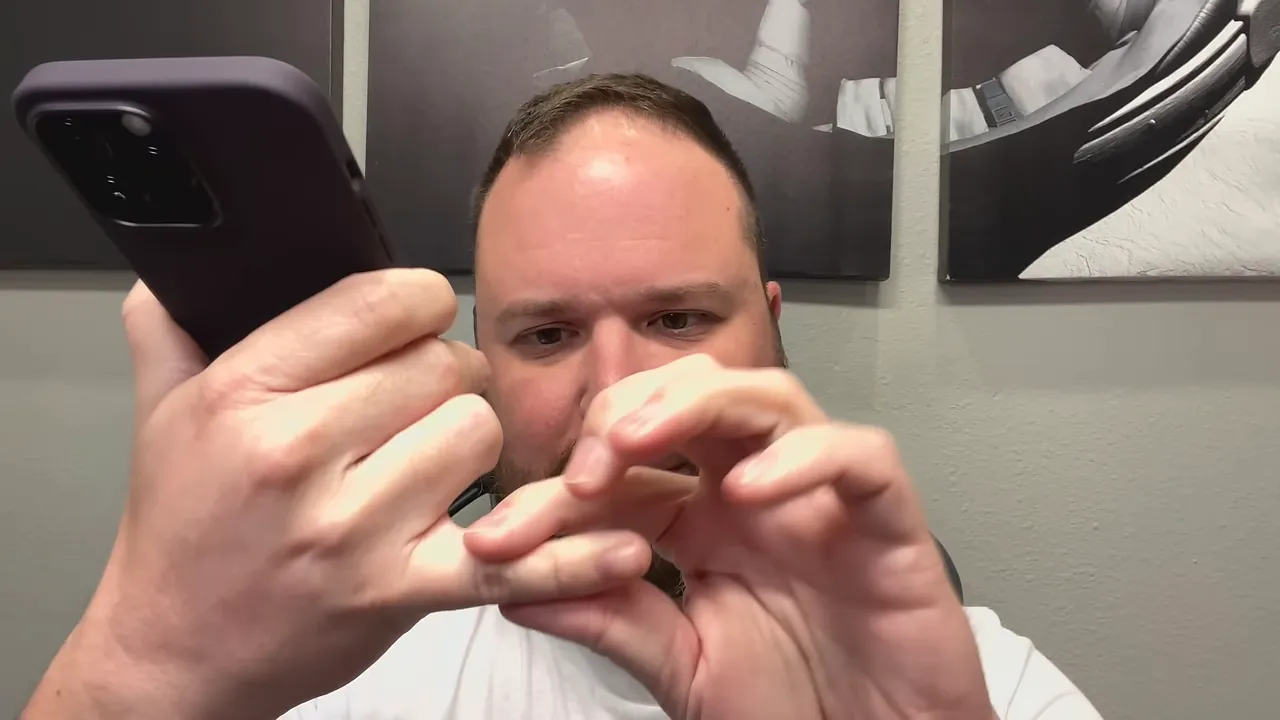
Something about the bulk, flat sides, and the way I grip these phones makes the Pro Max uncomfortable for me. I don't tend to have the same issue with other phones.
And this wasn't just a memory from an older model. The 14 Pro Max was already bothering my finger on the day I bought it.
That's why this wasn't a done deal. More battery and a bigger screen are great, but comfort matters when you're holding a phone all day. The smaller Pro could still be the better choice for me.
3. The Bigger Screen Fits My Nighttime Routine
The iPhone 14 Pro has a 6.1-inch display, while the iPhone 14 Pro Max moves up to 6.7 inches. That extra space was the third big reason I wanted to try it.
At night, I usually have two phones in the mix: an iPhone and my Galaxy Z Fold 4. Sometimes I'm using both at once.
A typical evening looks something like this:
- Galaxy Z Fold 4: Editing thumbnails and responding to things on YouTube.
- iPhone: Playing Netflix, Amazon Prime Video, or another video service.
So when I say I want more screen real estate, there's a specific use behind it. I'm not buying a larger display just to admire it. I spend enough time playing video on my iPhone that the extra space is appealing.
Before this, my iPhone SE 2022 often filled that everyday iPhone role. It was fine for normal pictures and short video clips, but I'd turn to the 13 Pro for recording my content and for better battery life when traveling.
Moving to the iPhone 14 generation made me reconsider that whole arrangement, partly because of eSIM.
How eSIM Complicated My Phone-Switching Routine
With my iPhone SE 2022 and iPhone 13 Pro, I could move a physical SIM between them depending on what I was doing. That flexibility mattered to me.
The US iPhone 14 models pushed me into eSIM. I considered importing an international model that still supported a physical SIM, but I didn't want the extra cost and hassle. My thinking at the time was that eSIM would become more common, so I might as well rip the Band-Aid off.
That was my expectation about the direction of the industry, not a guarantee about what every manufacturer would do next.
To be fair, transferring my AT&T eSIM from the iPhone 14 Pro to the Pro Max went well. It took only a couple of minutes, and I didn't have to go through the carrier directly.
But a friend told me his transfer took nine hours. That's an anecdote, not a typical transfer time, but it explains why I still had concerns. If you regularly move between phones, it's worth understanding your carrier's process before changing your setup. Apple's guide to eSIM on iPhone provides useful background.
For me, committing to a more dedicated everyday iPhone made the Pro Max's screen and battery more attractive. If I wasn't going to swap phones as casually as before, I wanted to try the model that better fit my everyday use.
A carrier reservation put my primary line on the iPhone
There was another complication. I normally prefer Android as my primary phone. I had something like 40 Android phones around, so buying a Pro Max wasn't a sudden conversion into an Apple fanboy.
I'd reserved an iPhone 14 Pro Max for my son as a birthday gift, using the secondary line that normally handled my iPhone. When I tried converting that line's physical SIM to eSIM, AT&T wouldn't let me proceed because of the pending reservation.
The alternative was to cancel the reservation. With availability already pushed out and that phone expected at the end of October, I didn't want to risk it.
So I ended up putting my primary line on the iPhone instead. For roughly the next month, I expected to use an iPhone as my main phone rather than moving that line between something like my Xperia 1 IV and Galaxy Z Fold 4.
Was I thrilled about losing that flexibility? Not really. But it gave me a reason to find out how the Pro Max worked as a primary phone, rather than just as a secondary device.
iPhone 14 Pro or Pro Max? Don't Choose on Habit Alone
I actually tried to order the Pro Max first. Apple's website was having problems, and during that interruption I talked myself into the smaller Pro. Stick with what you know. Don't do anything crazy.
Then I spent the next week or so kicking myself and checking availability until a Pro Max turned up at an Apple Store.
The useful lesson here isn't that everybody should buy the larger phone. It's that your current routine matters more than the size you've always bought.
- The Pro Max appealed to me because I needed more battery, wanted a larger display for video, and no longer needed my everyday phone to double as my recording phone.
- The Pro could still win because the smaller body is easier for me to live with, and the Pro Max was already causing discomfort.
And yes, I love the Deep Purple finish and the Elderberry silicone case. Purple is my color, so this was an unusually exciting iPhone release for me. For the record, I still think the iPhone 8 had the best shade of Product Red. I'll stand by that one.
But color isn't going to settle this decision. Battery life is king for how much I use my phone, while comfort is the reason I hesitated in the first place. The Pro Max earned a chance, not an automatic victory. One of these phones still has to go back.


